
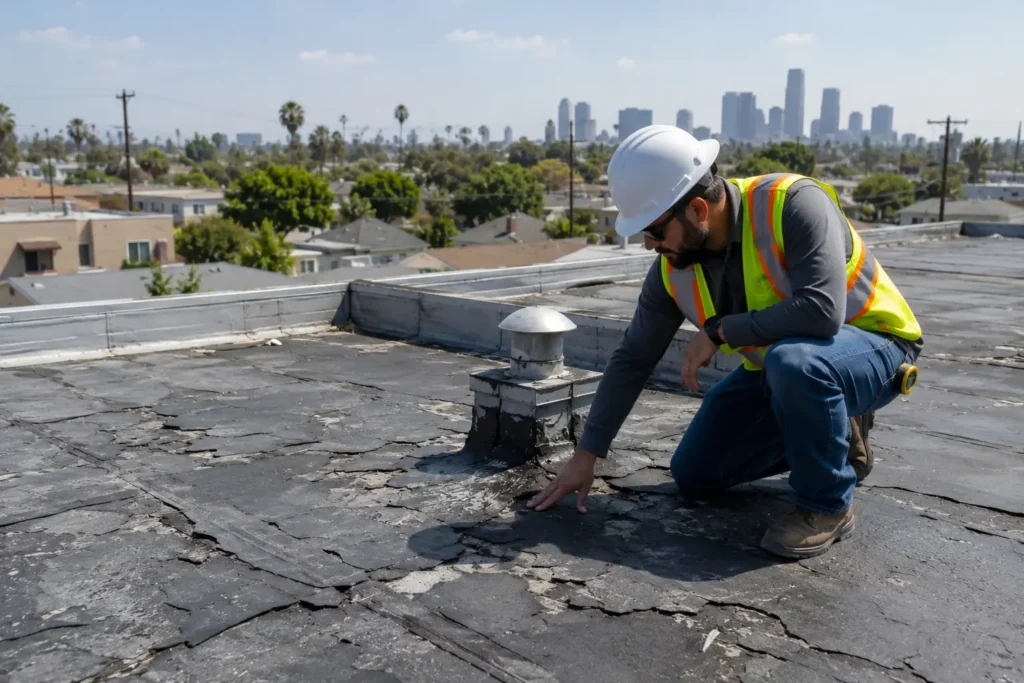
Flat roof repair Los Angeles specialists see the same problems repeat on homes and businesses across the city – and most of them were preventable.
Flat roofs are everywhere in Los Angeles. Commercial buildings, apartment complexes, modern residential additions, mid-century homes in Silver Lake and Echo Park – a large portion of LA’s housing stock sits under a flat or low-slope roof. And while they look simple compared to pitched roofs, they come with their own specific failure patterns that catch property owners off guard.
This guide covers what causes flat roofs to fail in LA, the warning signs to watch for, what repairs cost in 2026, and how to choose someone worth calling.
Why Flat Roofs in Los Angeles Fail
The logic seems straightforward – a flat surface, no complex angles, nothing to blow off in the wind. But flat roofs are actually more vulnerable to certain types of damage than pitched roofs, especially in the Los Angeles climate.
UV degradation is the biggest long-term threat. Flat roof membranes – whether TPO, EPDM, or modified bitumen – sit completely exposed to direct sunlight. In Los Angeles, that means UV exposure nearly every day of the year. Over time, membranes become brittle, surfaces crack, and the adhesive holding seams together starts to give.
Thermal movement accelerates the problem. LA temperatures shift significantly between summer afternoons and winter nights. The roof membrane expands and contracts with every cycle. Over years, this movement opens up seams – particularly around edges, drains, and penetrations like vents and HVAC units.
Poor drainage does the rest. Flat roofs depend entirely on properly placed drains and slight slopes to move water off the surface. When drains get blocked or the slope is inadequate, water sits. Even in a city that sees as little rain as Los Angeles, standing water is enough to find any weak point in the membrane and get through.
Warning Signs Your Flat Roof Needs Attention
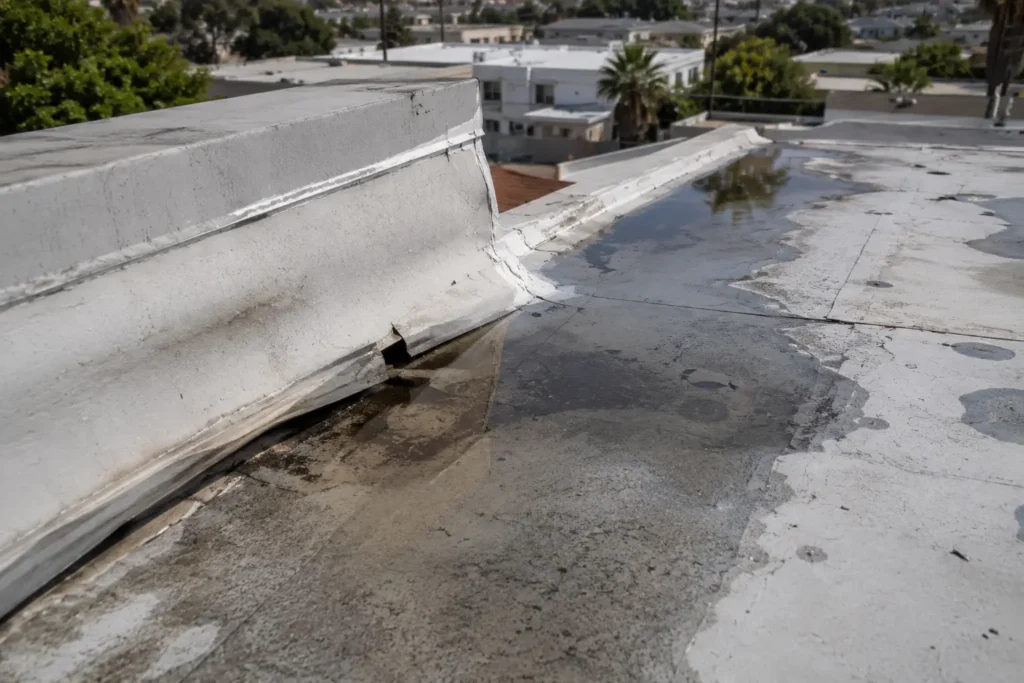
Most flat roof problems give clear signals before they turn into full leaks. The issue is that most property owners do not see them until water shows up inside.
Watch for these on your property:
- Bubbling or blistering on the roof surface – trapped moisture underneath the membrane
- Visible cracks or splits in the membrane, especially near edges and seams
- Standing water on the roof 48 hours or more after rain
- Roof surface that feels soft or spongy underfoot – a sign of wet insulation or rotted decking below
- Water stains on interior ceilings or walls near the roofline
- Daylight visible through the roof deck in an attic or upper floor space
- Flashing pulling away from parapet walls or around rooftop equipment
Any one of these is enough reason to get a professional up there. Two or more means the situation is already past the early stage. Our roof inspection service provides a full documented assessment – useful for understanding exactly what you are dealing with before spending anything.
Common Flat Roofing Systems in LA – And How They Fail
Knowing which system is on your property helps set realistic expectations for repair or replacement.
TPO – Thermoplastic Polyolefin
The most widely used flat roofing material on newer construction in LA. When installed correctly with heat-welded seams, it performs well. When seams are improperly welded or the membrane thickness is cut at the low end, seam failures show up within a few years. The repair – re-welding or patching seams – is straightforward when caught early.
EPDM – Rubber Membrane
Older and very common on mid-century residential and commercial properties across LA. Durable and proven, but adhesive-bonded seams are the consistent failure point. As the adhesive ages and dries out in the LA heat, seams lift and water finds its way underneath. Flat roof leak detection often reveals multiple entry points on older EPDM systems.
Modified Bitumen
Two or more layers of bitumen-reinforced membrane, typically torched or self-adhered. Very common on apartment buildings and older commercial properties across central LA. Fails most often at flashings around parapets and rooftop equipment. When modified bitumen gets to end-of-life, repairs become a temporary fix – replacement is usually the better investment.
Built-Up Roofing – BUR
Still found on older buildings across east and downtown LA. Multiple layers mean it tends to fail gradually rather than suddenly. Drainage points and penetrations are the first to go. A professional flat roof repair assessment will tell you whether a BUR system has viable years left or whether replacement makes more financial sense.
What Flat Roof Repair Costs in Los Angeles in 2026
Flat roof repair pricing in LA is higher than the national average – local labor rates, permit requirements, and material costs in Southern California all push numbers up compared to other markets.
Realistic ranges for 2026:
- Seam repair or membrane patch – $400 to $900 per repair area
- Flashing repair at parapets or equipment – $600 to $1,800
- Roof drain repair or replacement – $500 to $1,200
- Full roof coating application – $3 to $6 per square foot
- Partial membrane replacement – one section – $4,000 to $12,000
- Full flat roof replacement – $8 to $18 per square foot depending on system and access
A 2,000 square foot flat roof on an LA residential property getting a full TPO replacement typically runs between $16,000 and $28,000 installed. Commercial properties with HVAC penetrations and more complex drainage add to that range.
For a full cost comparison by roofing type and property size, our roof replacement cost guide covers the numbers in detail.
How to Choose a Flat Roof Specialist in Los Angeles
Not every roofer has experience with flat roofing systems. It is a different skill set from pitched residential work – different materials, different tools, different diagnostic approach.
When evaluating contractors:
- Verify their C-39 license – California’s required license for roofing work over $500. Check any contractor instantly at cslb.ca.gov before committing to anything
- Ask specifically about flat roof experience – how many flat roofs have they worked on in the last year, which systems do they work with, can they show references from similar properties
- Get written bids with material specs – the membrane thickness, brand, and warranty terms should be in writing. A bid without material specs is not a real bid
- Check manufacturer certification – if a contractor claims to offer a manufacturer warranty on TPO or EPDM, verify they are actually certified by that manufacturer to install it
- Be cautious of same-day pressure – legitimate specialists give you time to review. If someone is pushing you to sign on the spot after a storm, that is a sales tactic, not an emergency response
If your flat roof is already leaking, our emergency roof repair team handles urgent situations across Los Angeles – same-day response when available.
The Right Time to Act on a Flat Roof Problem
The window between early warning signs and expensive structural damage is shorter on flat roofs than most people expect. Water sitting on a compromised membrane finds its way through quickly – and once it gets into the insulation layer or roof deck, the repair scope grows significantly.
A repair that costs $800 in March can turn into a $12,000 deck replacement by summer if the membrane failure goes unaddressed through the rainy season.
American Roofing CA handles flat roof repairs, leak detection, and full replacements across Los Angeles – residential and commercial. Licensed, insured, and familiar with the specific permit and material requirements across LA County jurisdictions.
Call (213) 671-0993 or contact us online for a free flat roof assessment.
Leave a Reply